Digital Systems#
Digital v.s. Analog#
| Digital | Analog | |
|---|---|---|
| Definition | a discrete set of values | continuous values |
| Example | {0,1} | -8.0 to 12.0 |
| Exact example | PC | The microphone & speaker of a sound system |
| Advantages | Digital data can be stored compactly. | X |
| Advantages | Noise does not affect digital data as much as analog data. | X |
| Advantages | More reliable than analog data. | X |
Signal#
For digital systems, the variable takes on discrete values : Two level, or binary values are the most prevalent values
Binary values are represented abstractly by :
- digits and
- words (symbols) False () and True ()
- words (symbols) Low () and High ()
- and words On and Off.
This is the Binary logic that we use.
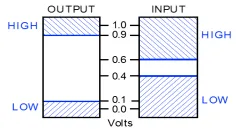
We can use Voltage Range to define logic 1 and logic 0 in electronic devices.
Digital System#
Info:
A digital system is an interconnection of digital modules.
To understand the operation of each digital module, it is necessary to have a basic knowledge of digital circuits and their logical function.
A major trend in digital design methodology is the use of a HDL (Hardware Description Language) to describe and simulate the functionality of a digital circuit, it is important that students become familiar with an HDL‐based design methodology.